
Small-scale supply chains in action
How do we undertake production that goes against the prevailing economic logic?

This is the second instalment of a talk I gave at Cambridge University in 2025 called ‘‘provisioning a place-sourced, bioregional future through natural systems and small supply chains’. It’s a few months late because I forgot to post it, oops!! I do apologise for the delay. You can find the first post here.
The Cambridge talk was based on research, theory and concepts developed via a Churchill Fellowship I received in 2024. This will be the last in a series of writings that have evolved from this project as we now move into action on the ground.
Bioregional Demonstration
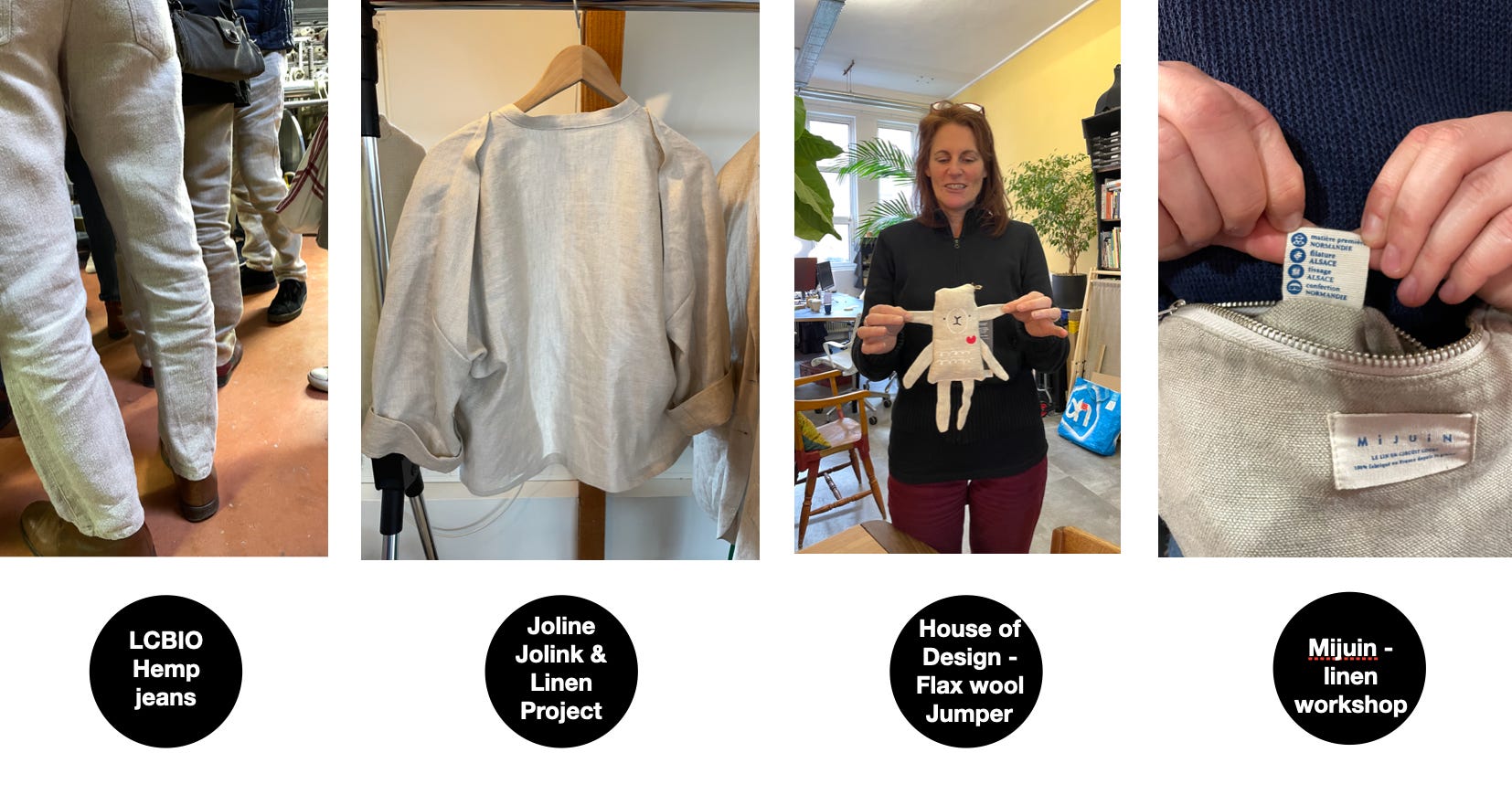
To demonstrate the possibilities of localised production we need real life products that people can hold in their hands. These are items at the end of the supply chains. I call them bioregional demonstration products – tangible items grown and made in place – and they carry immense value beyond the financial. They embody shared purpose, materials and stories, showing what new systems of production can achieve. The following projects, seen left to right in the image above, show what these can look like:
1 - Lin et Chanvre Bio, (French organic linen and hemp association) coordinated farmers, processors and makers in France to produce 200m of hemp cloth and 100 pairs of jeans, distributed to participants and key figures such as the Mayor of Normandy. The jeans became powerful symbols of collective effort, far more persuasive than reports or presentations.
2 - The Linen Project co-founded by Willemien Ippel and Pascale Gatzen in the Netherlands, has created the first dutch linen cloth in years, woven into garments such as Joline Jolink’s linen jacket, carrying the pride of its makers.
3 - House of Design in Groningen, led by Eileen Blackmore, has produced multiple flax-based items, beginning with small souvenirs that seeded wider engagement and infrastructure. Blackmore stresses how bioregional products strengthen community identity, retain young people, and showcase “the magic of flax.”
4 - Mijuin, founded by Pauline Beuzelin in Normandy, France, uses only local organic linen to create products that directly embody farming and place.
Bioregional products can serve as cultural totems, making visible the connections between land, people and process. Their relational value far exceeds monetary worth, inspiring communities by embodying place, history and potential futures.
Hemp Production
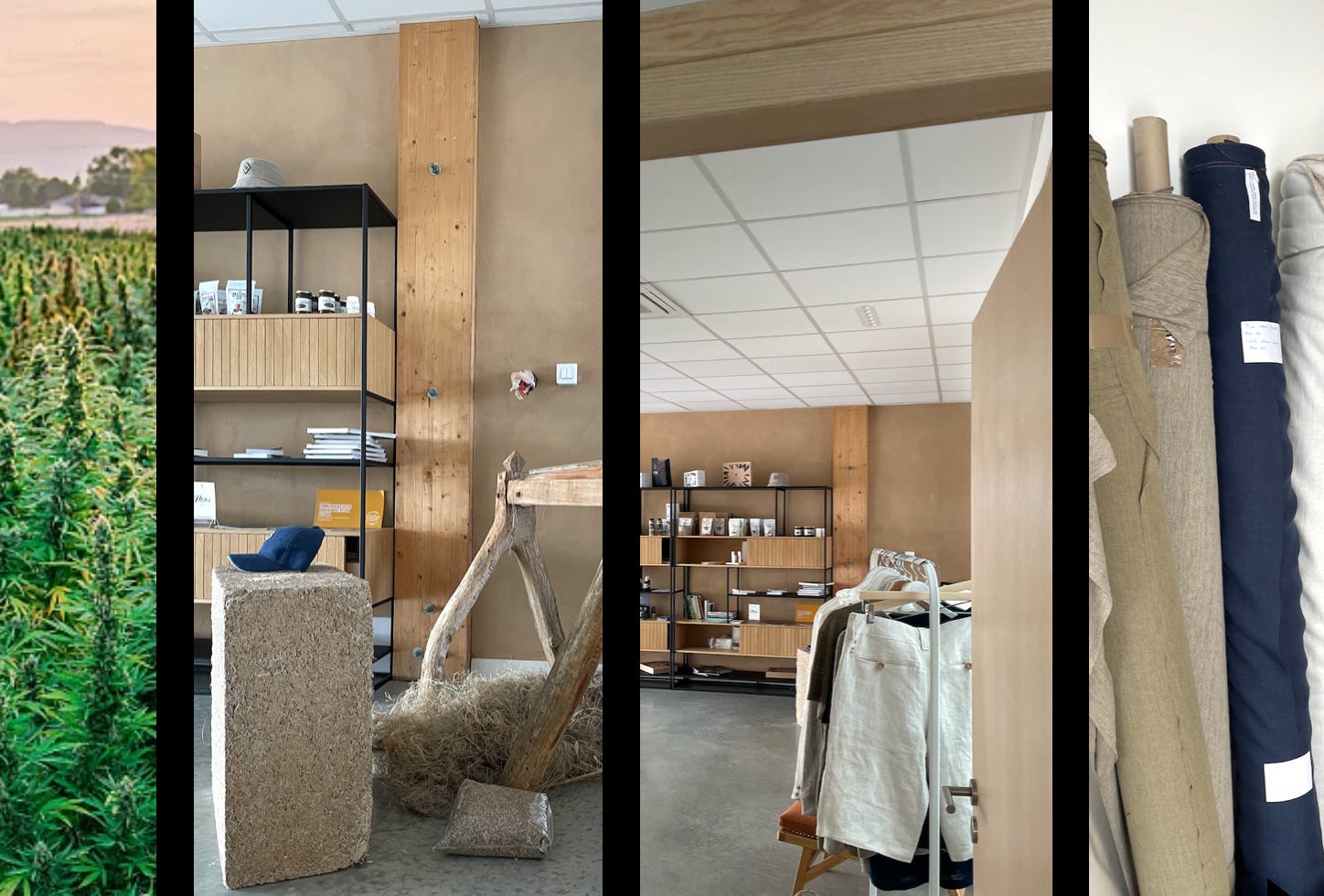
At Les Chanvres de l’Atlantique, in Saint-Geours-de-Maremne, Southwest France, they also make demonstration products on a mid scale and utilise all aspects of hemp fibre from food to building materials and cloth. All require slightly different and carefully planned growing, harvesting and processing but in a holistic, vertically integrated system they can work well together. They start with the hemp plant itself and build corresponding relationships carefully with the land, seasons, climate and organic farmers outwards from this. This care and attention is paramount if the entire system is to thrive.
Cooperative Cultures
Re thinking governance requires changing how we organise, share knowledge, and develop structures emphasising value beyond the monetary. Systems that encourage cooperation require more social input but have many long-term and wide-reaching benefits. Cooperatives provide an enterprise container that can embody agroecological values such as social and ecological care.
Due to the complexities of organising complex fashion supply chains, textile cooperatives are a rare form of business around the globe. However, we can find some inspiring examples in France and Spain. The French in particular like to work in coops, with 22,000 cooperative enterprises compared to 7000 in the UK, and development of the ‘social solidarity economy’ supported by a ‘Minister for the Ecological and Solidarity Transition’.
Virgo Coop, is an inspiring hemp processor and fabric producer in the Occitanie region, using stakeholder and worker coops to progress collaboration and mutual benefit between farmers, builders, mills and weavers. They manage a decortication coop transforming organic hemp and a weaving coop. Virgo buys local wool to blend with the hemp they grow and have partnerships with spinners in France and Poland.
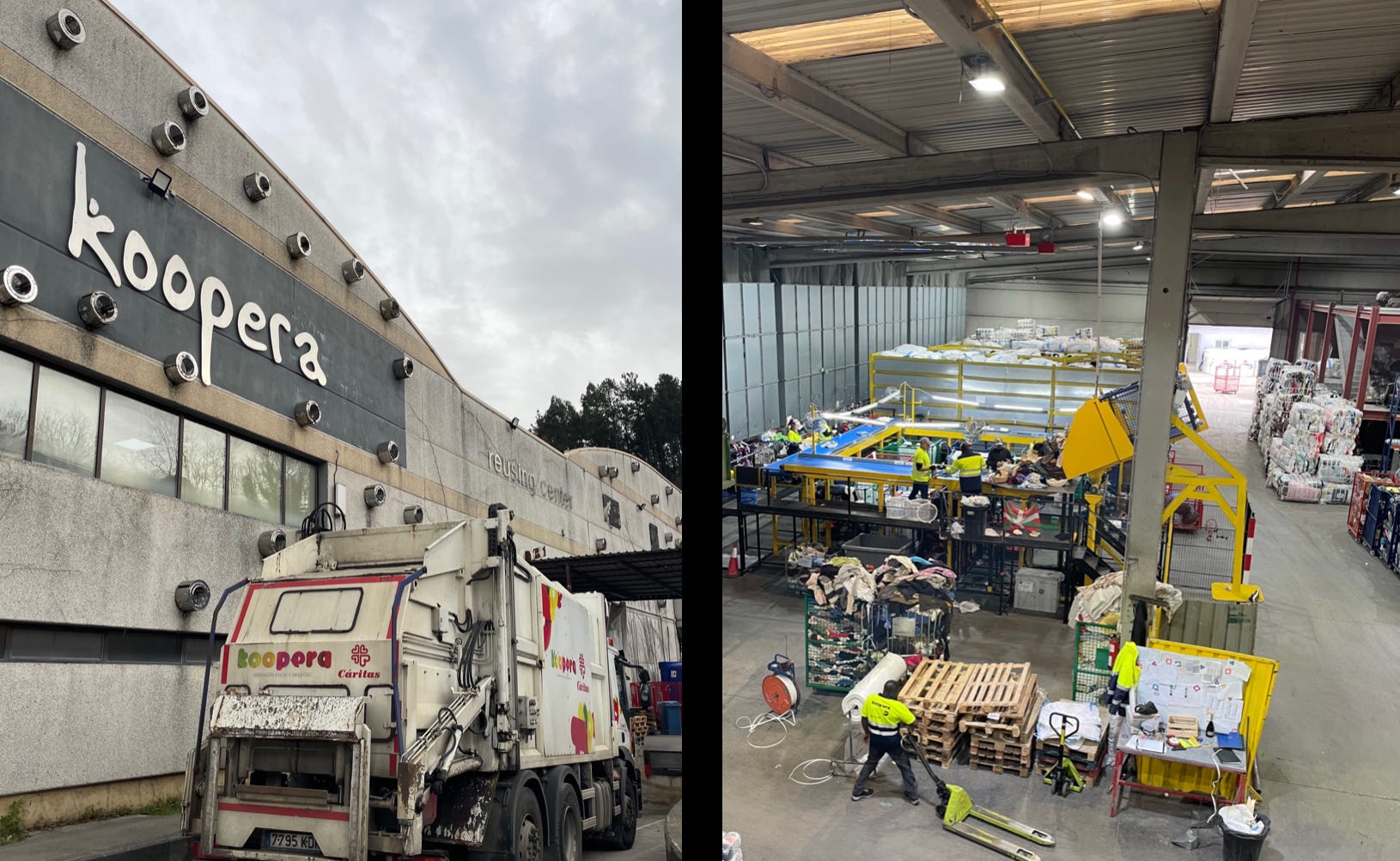
Similarly, Koopera is a textile waste collection and re-use clothing cooperative operation near Bilbao in the Basque area of Northern Spain. Their work over the last 40 years to collect waste, reuse it and support social integration and livelihoods is a phenomenal example of what can be achieved when you put people before profit. 300 cooperatives (staff) work collectively with no hierarchy - only democratically agreed management - supporting another 300, often seriously disadvantaged people through schemes of integration and training. Their advanced and well organised facility feels like being at the coalface of fashion.
Producer Collectives
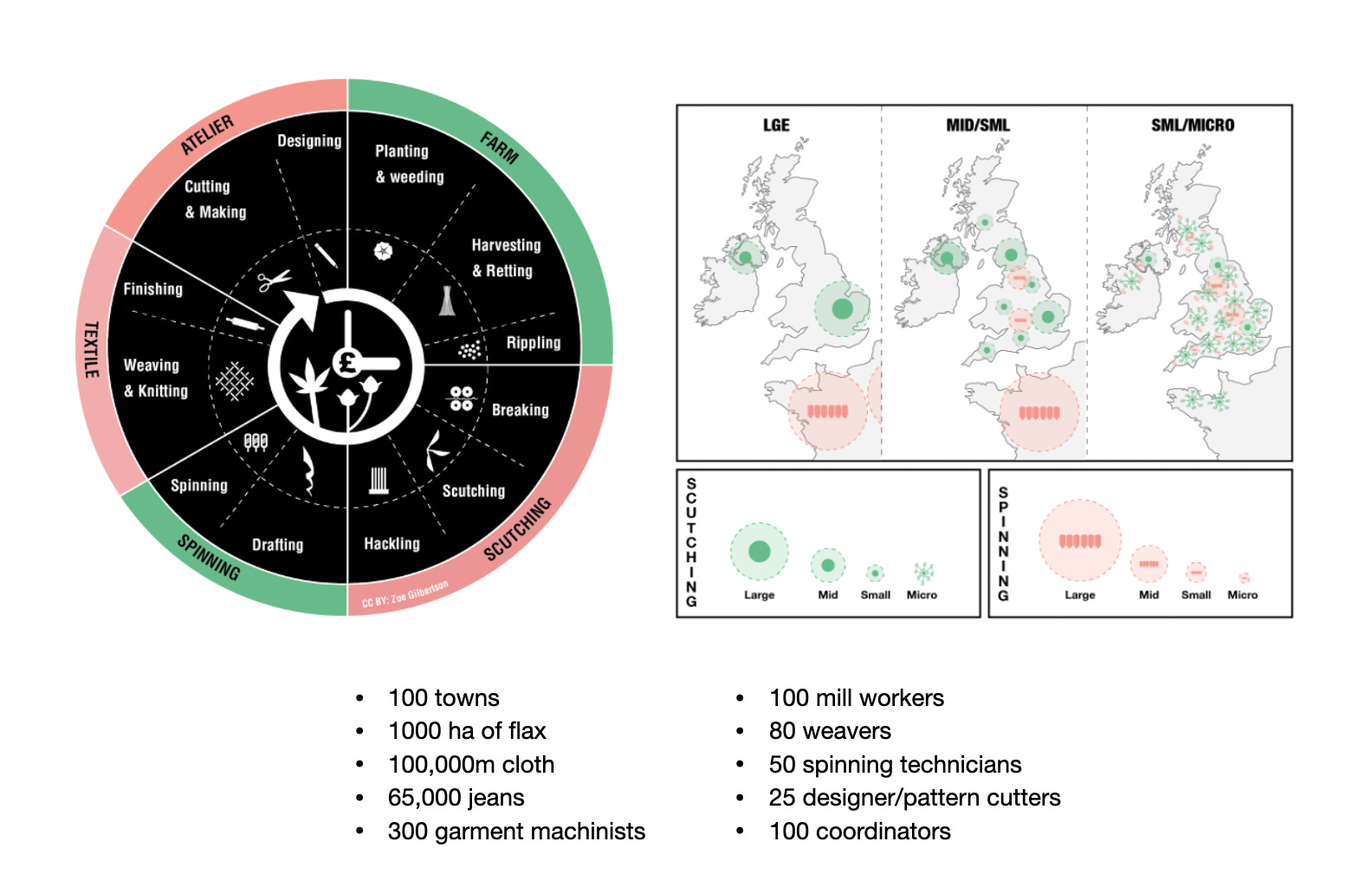
To sum up and produce a vision for these examples and concepts, 1 ha worth of flax can produce almost 1000 m of fabric per year and 650 pairs of jeans. This diagram illustrates the actors and places within the process, some of these roles and places could be undertaken in the same location by the same people if desired.
For example, using the vehicle of a local CSA scheme (community supported agriculture), as exists with organic vegetables, people could commit to a linen ‘produce’ box over a year. This concept proposes that value, roles and process across the supply chain could be apportioned fairly in relation to time and monetary value in a distributive, commons-based system. The revenue from the system should be able to support enough for all. I wont go into the numbers but the potential is palpable.
A producer collective, combined with distributed production could reimagine a whole system. One can extrapolate that producer collectives in 100 rural market towns or villages could produce:
• 1000 ha of flax
• 100,000m cloth
• 65,000 jeans
• 300 garment machinists
• 100 mill workers
• 80 weavers
• 50 spinning technicians
• 25 designer/pattern cutters
• 100 coordinators
These figures are over simplified but illustrate meaningful livelihood creation, leading to more resilient and varied rural employment by bringing in the potential of fibre, textiles and clothing. Once you understand the system and the consequences of scale you can start to make well informed decisions.
A combination of medium, small scale and micro scale set-ups will create a resilient, bioregional agroecological economies made up of food and fibre enterprise. The work is now to demonstrate this and create experimental small scale enterprises that can learn and grow together. Some of the projects that have Liflad has helped developed so far are:
South West textile Commons - sharing funding and knowledge with an aim to develop decentralised textile production, supporting fibre farmers, processors and micro-enterprises.
European textile Commons - sharing knowledge across borders as small-scale flax fibre and textile processing systems develop.
Totnes Grows Flax and Devon Grows Flax - communities learning to grow and process local fibre flax with the aim to develop culture, creativity and well-being.
South Devon Fibre Hub - demonstrating agroecological textile production from flax seed to linen cloth.
We are putting the concepts mentioned into action, experimenting to see if new scales and ecosystems are possible. This creates hyper-local, context-led action held gently by a wide boundary systems view and strongly held duties of care. We cannot wait to start producing our own tangible, hold-in-your-hand, outputs.